If you’re suffering from ear wax-related symptoms like reduced hearing, tinnitus, and earache, then you must have looked for ear wax removal methods. You might have tried olive drops, earbuds, or cotton buds to remove excess ear wax, but with no solution.
According to BBC News, ear wax buildup affects millions of people across the UK every year, and for most of them, the frustrating part isn’t the wax itself. It’s not knowing what to do next. Since most GP surgeries stopped offering ear wax removal, patients are left searching for answers on their own.
This is where the choice between microsuction vs ear irrigation comes in. Both are safe, professional methods performed by qualified audiologists. Both can give you instant relief and clearer hearing in a single appointment. But they work differently, suit different patients, and one may be significantly more appropriate for your ears than the other.
In this guide, we’ll explain exactly how each method works, who they’re best suited for, and how to decide which is right for you.
What Is Ear Wax and When Do You Need Ear Wax Removal?
Earwax (cerumen) is a naturally produced in your ear canal that acts as a lubricant and a barrier to prevent dust and debris from entering your eardrums. It usually removes itself through the body’s natural jaw movement. But for some people, excess production or narrow/curved ear canals prevent natural migration, leading to ear wax accumulation and causing ear wax blockage.
Ear wax build-up can also happen due to excessive use of headphones, cotton buds, hearing aids, and earplugs, as this often pushes the ear wax deeper into the ear canal, where it compacts into a blockage.
A professional ear wax removal is needed when you experience the following symptoms:
- Blocked or full feeling in the ear
- Muffled or reduced hearing
- Tinnitus (ringing or buzzing)
- Earache or itching
- Dizziness or balance issues
If you want to learn more about how ear wax build-up happens and when you should get it removed, read this blog, “What Causes Earwax Build-Up and When Should You Get It Removed?”
Ear wax removal helps solve all these problems through professional, clinically reliable, and safe practices. GPs can no longer offer ear wax removal services due to the NHS classifying it as a non-essential service. This means the only choice to get a safe and effective way to remove excess ear wax is to visit a local ear clinic.
To get a better understanding of when you might need ear wax removal, read this blog, “7 Signs You Need Professional Earwax Removal.”
What Is Microsuction and How Does It Work?
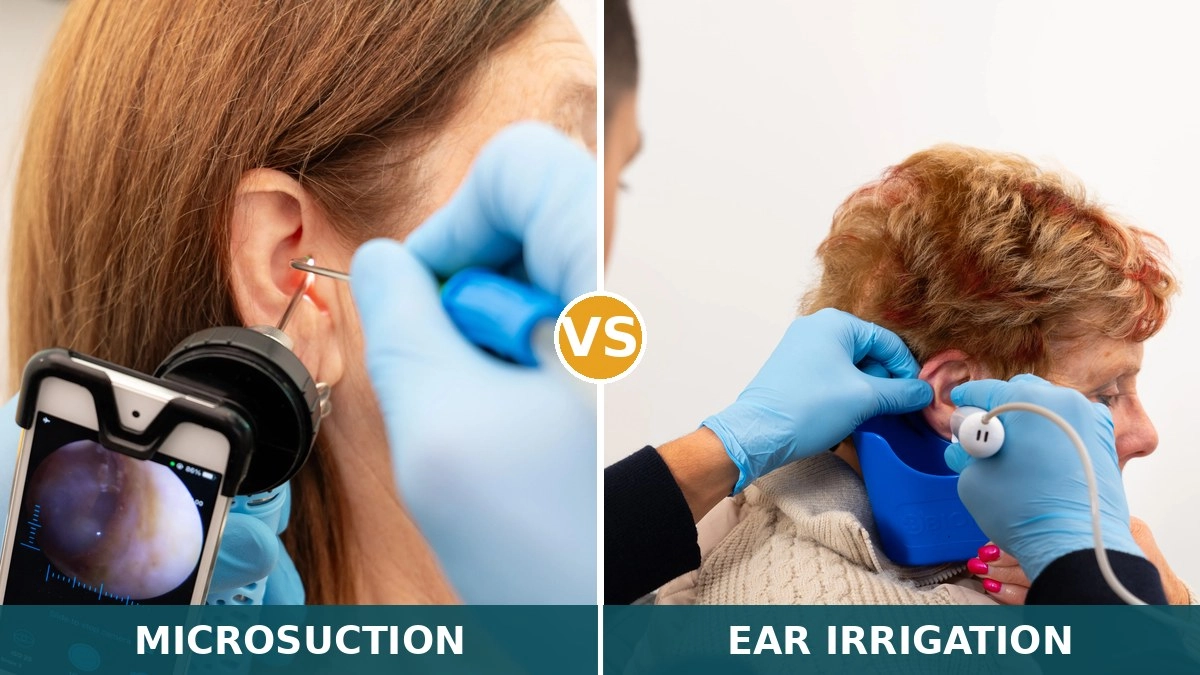
Microsuction is one of the safest and most effective methods of ear wax removal. It’s a dry, non-invasive procedure carried out under magnification with no water involved, that uses gentle suction to remove excess ear wax.
Here is how it works:
- An audiologist examines your ear using a microscope or endoscope for a clear view
- A gentle low-pressure suction device is used to remove the earwax.
- Ear wax is directly extracted without water or chemicals
Pros and Cons of Microsuction
| Pros | Cons |
| No water; clean and dry | Mild suction noise during the procedure |
| Precise, via microscope/endoscope | Requires specialist equipment |
| Safe for perforated eardrums | Slightly higher cost vs syringing |
| Suitable for hearing aid users | May not dislodge very dry, impacted wax without pre-softening |
| Fastest results | |
| Preferred by audiologists |
At Direct Ear Care, microsuction is the preferred method because it is safe, hygienic, and effective for the widest range of patients. Get a more in-depth understanding of how ear wax microsuction works by reading this blog, “Ear Wax Microsuction in Manchester What It Is, How It Works, and What to Expect.”
What is Ear Irrigation and How Does It Work?
Ear irrigation uses warm, temperature-controlled water gently directed into the ear canal by a specialist electronic irrigator. The controlled flow loosens and flushes out the wax. Modern irrigation uses low, regulated pressure a significant improvement on the unpredictable manual metal syringes of the past.
Here is how it works:
- The audiologist directs the electronic irrigator nozzle at the opening of the ear canal, nothing is inserted deep into the ear
- Warm water is gently flushed into the canal to loosen and wash out the wax
- The electronic irrigator works at low, controlled pressure for a comfortable experience
The procedure takes around 15 to 30 minutes. For harder wax, pre-softening with olive oil drops for five to seven days beforehand is recommended to make removal more effective.
Learn more about ear irrigation from this blog, “Is Ear Irrigation Safe? Risks, Benefits and Alternatives”
Pros and Cons of Ear Irrigation
Pros | Cons |
Highly effective for soft or stubborn earwax | Not suitable for perforated eardrums |
Gentle, comfortable sensation | Not safe with certain ear conditions (infections, previous surgery) |
Widely available | Pre-softening required |
Well-established technique | Higher risk of ear infection |
Microsuction Vs Ear Irrigation: Comparison Table
Factor | Microsuction | Ear Irrigation |
How it works | Gentle suction via microscope/endoscope | Warm water flushed into the ear canal |
Uses water? | No, dry procedure | Yes, wet procedure |
Pre-softening needed? | Recommend 3-5 days | Recommended (7–14 days of olive oil drops) |
Suitable for a perforated eardrum? | Yes | No |
Safe for hearing aid users? | Yes | Yes |
Suitable for ear infections/surgery history? | Often suitable; the audiologist has to assess | No |
Precision & visibility | High; direct view under magnification | Moderate; indirect removal |
Comfort level | Very comfortable; mild suction sound | Comfortable; mild wet sensation |
Duration | 15–30 minutes | 15–30 minutes |
Audiologist recommendation | Gold standard method | Good alternative for appropriate patients |
Risk of complications | Very low | Low (when performed by a professional) |
Available at Direct Ear Care? | Yes | Yes |
Which Ear Wax Removal Method Is Right for You?
Microsuction Is Best If:
- You wear hearing aids: Regular hearing aid use can accelerate earwax build-up and push it deeper into the canal. Microsuction is the recommended method for hearing aid wearers because it's precise, dry, and won't interfere with your devices.
- You have or have had a perforated eardrum: Microsuction uses no water, making it the appropriate option in most cases.
- You've had ear surgery or recurring ear infections: microsuction gives the audiologist direct, magnified visibility to work safely and no water is used.
- You want results with less preparation: Microsuction typically needs 3-5 days of pre-softening.
Ear Irrigation May Suit You If:
- Your earwax is very soft: Ear Irrigation works particularly well when the earwax is very soft and if it’s close to the eardrum.
- You've been using olive oil drops beforehand: If you've softened the wax over 7–14 days, irrigation can flush it out comfortably and effectively in a single session.
- You have no history of ear conditions, surgery, or a perforation: For patients with otherwise healthy ears, irrigation is a safe, well-established, and comfortable option.
A Word on Doing It Yourself
It’s worth addressing what many people try before seeking professional help: cotton buds, ear candles, and over-the-counter ear drops. While these feel like logical first steps, they often make things worse.
Cotton buds push wax further into the canal rather than removing it. Ear candling has no clinical evidence behind it and carries a real risk of burns and blockages. Drops alone can soften earwax but won’t clear a significant build-up on their own.
If your ears feel blocked, professional earwax removal is the safest and most effective route, and in most cases, it takes less than 30 minutes.
What About Ear Syringing?
Ear syringing is an old NHS practice that involved using a metal and manually operated syringe to flush out ear wax. This method was largely discontinued because of a higher risk of complications.
Modern ear irrigation is a much safer and evolved version of this procedure that uses the same concept but controlled electronically with regulated pressure and temperature.
Because GPs in the UK have largely stopped offering earwax removal, private audiologists are now the main option for most patients seeking safe, professional treatment.
How Direct Ear Care Offers Both Treatments
At Direct Ear Care, both microsuction and ear irrigation are available at every appointment. You don’t need to arrive having already decided; your HCPC-registered audiologist will examine your ears first and recommend the most appropriate method for you on the day.
Here’s why patients across the Northwest trust Direct Ear Care for professional ear wax removal.
1. HCPC-Registered Audiologists with Years of Experience
An HCPC-registered audiologist carries out every procedure. The team has treated over 5,000 ears and holds memberships with BSHAA and the British Society of Audiology. That clinical depth makes a meaningful difference, particularly for patients with a history of ear conditions who need the right method chosen carefully.
2. You Can See the Results
Before any treatment begins, your audiologist uses a microscope or endoscope to examine the ear canal directly. This determines which method is safest and most effective for your wax type and ear anatomy. After removal, they will show you before-and-after videos of your ears, so you can actually see the result, not just feel it.
3. Both Treatments Are Completed in Under 30 Minutes
Whether microsuction or ear irrigation is used, most appointments are completed within 30 minutes, and results are immediate. Every ear wax removal appointment also includes a free hearing test worth £39, giving you a complete picture of your ear health in one visit.
4. Home Visits Available If You Can't Travel
Direct Ear Care offers ear wax removal at home with the same professional standard, bringing the same equipment and expertise directly to your door. Clinic appointments start at £59 for one or both ears; home visits are £75, with transparent, fixed pricing and no hidden fees.
5. Trusted By Thousands of Patients
Direct Ear Care is an independent clinic that holds a 5.0-star rating across more than 850 Google reviews.
Conclusion
Both microsuction and ear irrigation are safe, reliable, and clinically effective methods of removing ear wax. They work differently, but both provide immediate relief from a blockage. Microsuction is usually the preferred choice for most patients due to its precision and suitability for a wider range of ear conditions. Ear irrigation is an excellent option, where clinically appropriate.
The right ear wax removal method depends on the extent of the ear wax blockage, any pre-existing ear condition, ear sensitivity, and eardrum health. All of which can be accurately assessed with a professional hearing test or assessment by a certified audiologist. The best approach is never to decide blindly, but to be examined first and guided to the safest option for your ears.
Book Your Free Hearing Test At Direct Ear Care Manchester
CTA: Call 0330 133 0511 | Book an Appointment Online
Written and medically reviewed by:

Ibrahim Musa
Audiologist
Frequently Asked Questions
Is microsuction better than ear irrigation?
It depends on your ears. Microsuction is generally considered the gold standard by most audiologists because it doesn’t use water, gives the practitioner direct magnified visibility throughout the procedure, and is suitable for a much wider range of patients, including those with perforated eardrums, previous ear surgery, or hearing aids. For most people, it’s the safer, more precise option.
That said, ear irrigation is a perfectly effective treatment for patients with soft wax, healthy eardrums, and no history of ear problems. The honest answer is that neither technique is universally “better”, which is exactly why a proper ear examination before any treatment matters so much.
Is ear irrigation painful?
Not at all. Modern ear irrigation is completely different. It uses an electronic irrigator that delivers warm, temperature-controlled water at a carefully regulated low pressure. Most patients describe it as a mild, slightly odd sensation when the water moves around in their ear, but not painful. If anything causes discomfort, your audiologist will stop immediately and reassess.
Can I have microsuction if I have a perforated eardrum?
Yes, for most patients with a perforated eardrum, microsuction is the only appropriate professional option. Introducing water into an ear with a perforated eardrum carries a risk of infection and further damage, which rules out irrigation entirely. Microsuction avoids water altogether, using gentle suction under direct magnified view, making it significantly safer in this situation.
Your audiologist will always examine your ears before starting any treatment, so if there’s any question about the condition of your eardrum, which will be picked up and factored into the decision.
How long does microsuction take?
Appointments are 45 minutes from start to finish, and that includes the initial ear health check, the removal itself, and a free hearing assessment at the end. There’s no waiting for drops to take effect, no prep, and no mess. You’ll notice the difference the moment the wax is out.
Patients often describe walking out and being surprised by how much sound they’d been missing.
Do I need to use olive oil drops before my appointment?
For ear irrigation, yes. Using olive oil drops two times a day for 7 to 14 days before your appointment softens the wax, which makes it considerably easier to flush out. However, this doesn’t mean that ear drops are mandatory, but it does give it the best possible chance of being effective in a single session.
For microsuction, pre-softening isn’t usually necessary. The suction and direct visibility allow the audiologist to work effectively even with harder, more compacted wax. That said, if you’ve been told your wax is particularly stubborn or deeply impacted, a few days of olive oil beforehand won’t do any harm and may make the appointment quicker and more comfortable.
Related posts
How Often Should Adults Have Their Hearing Checked?
Rechargeable Hearing Aids vs Battery Hearing Aids: Which Is Better?